
Quick Links
Elementary Program: 6-9 years old
Montessori education is grounded in the pedagogical principles developed by Dr. Maria Montessori, shaped by her extensive observations of children and her profound understanding of the true aims of education.
This approach honors each child’s individuality within a collaborative classroom community, nurturing their personal, intellectual, and social growth through a rich range of developmentally appropriate experiences. The program for children ages six to nine builds on the foundation established in the early childhood years and responds to their expanding curiosity, growing reasoning mind, and increasing interest in the world beyond the classroom.
Children in this stage are strong, coordinated, and eager for active, physical play. They have an immense appetite for knowledge and a growing ability to imagine ideas beyond their immediate experience.
Their expanding interest in the wider world often shows up as a passion for collecting, exploring big concepts, and asking profound questions. They are curious not only about the biggest, oldest, or longest things, but also about how and why the world works, what is right and fair, and what their own place might be within it.
Children at this age freely share their ideas and enthusiasm, enjoy humor, and take pride in their accomplishments. It is a time of hero worship and deepening friendships, with a strong desire to belong. They practice negotiating, debating, and compromising as they navigate their social world. At the same time, they continue to look to their parents with admiration and hold family values with confidence.
Curriculum
- Development of the Reasoning Mind: Children move from hands‐on
exploration to intellectual inquiry, using imagination and reasoning to
understand the world. - Integrated Curriculum: Subjects are interconnected, allowing children to
see relationships across science, history, language, and mathematics. - Independence and Responsibility: Students take ownership of their
learning, managing time and projects with growing confidence. - Collaborative Learning: Mixed‐age classrooms (ages 6–9) encourage
mentorship, cooperation, and empathy. - Role of the Teacher: The teacher serves as a guide and facilitator, inspiring
curiosity and connecting students with meaningful work. - Prepared Environment: Classrooms are rich with materials that support
exploration, creativity, and deep concentration.
Practical Life
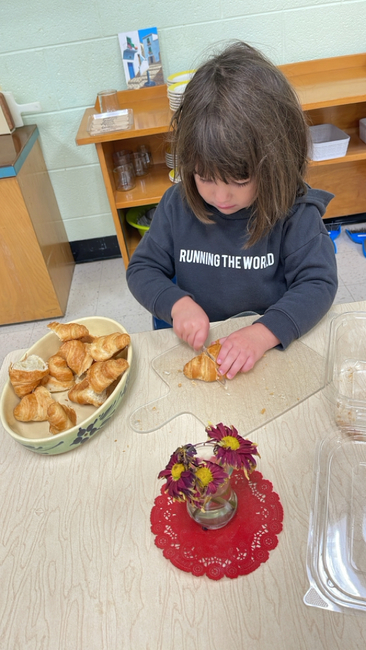
Competence in daily life and work grows through social awareness and the steady practice of skills and habits modeled and reinforced each day in the elementary classroom. Lessons and activities nurture responsibility and independence through attention to health, safety, and hygiene; grace and courtesy; care and maintenance of the environment; food preparation; and the tending of plants and animals.
Organization and effective study habits are supported by clear expectations and tools such as work plans, daily agendas, and calendar deadlines. Classroom ground rules ensure respect for both individual and group needs, and children take an active role in defining and upholding them. Regular class meetings provide opportunities for discussion, thoughtful expression of concerns, and collaborative problem‑solving within a respectful community.
Mathematics
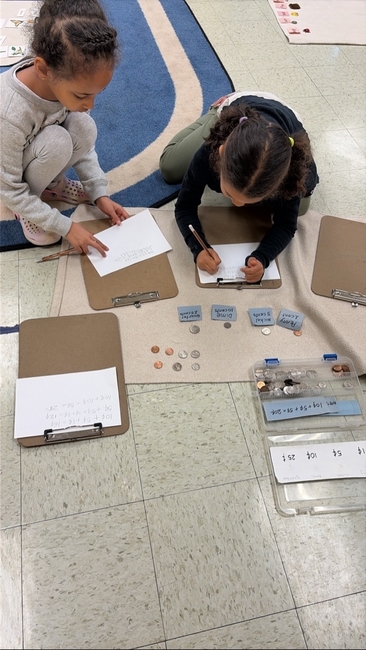
In the Elementary classroom, children work with increasingly large numbers—sometimes reaching into the millions—using materials that gradually transition from concrete to symbolic representation.
The curriculum includes mastery of basic number facts, fractions, decimals, multiples, factors, divisibility, squares and square roots, binomials, trinomials, decanomials, prime numbers, and negative numbers. As their understanding deepens, children explore ratios and percentages, algebraic equations, measurement, probability, estimation, statistics, and graphing—building a strong foundation for logical reasoning and problem‑solving.
Language
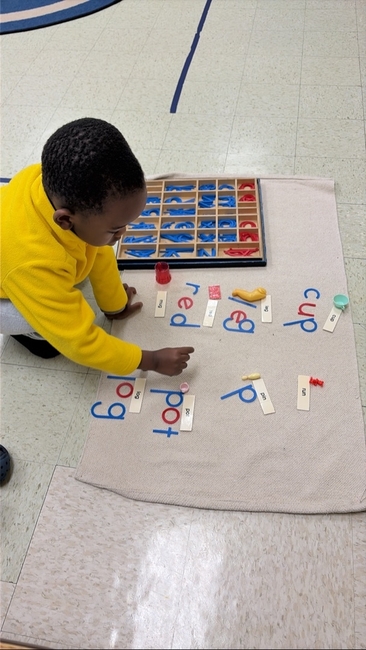
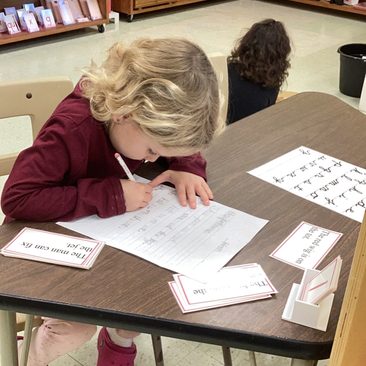
The Montessori Elementary teacher meets each child where they are, offering lessons that match individual readiness and build confidence. As their competence grows, children read and write extensively throughout the day—immersing themselves in research, composing stories, and preparing oral and written presentations of their work.
Language lessons and exercises strengthen vocabulary and spelling, clarify grammar and syntax, and refine comprehension and expression. Regular group discussions encourage thoughtful dialogue, helping children learn to analyze, critique, and express their own ideas with clarity and respect.
Cultural
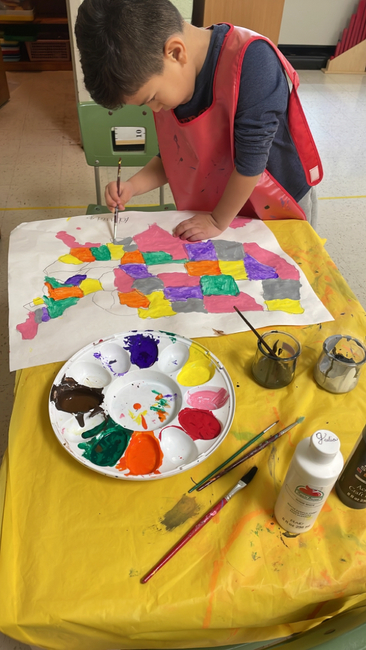
Each year, children in the Elementary I classroom are introduced to the Five Great Lessons:
-
The Origins of the Earth (Physics, Chemistry, Geology, Geography)
-
The Coming of Life (Evolution and Biology)
-
The Coming of Human Beings (Human Evolution, History, Fundamental Needs, Creativity)
-
The Invention of Writing (Communication)
-
The Invention of Numbers (Mathematics)
These impressionistic stories are brought to life through charts, timelines, science demonstrations, and artifacts that the children revisit and explore throughout the year. The subject areas introduced through the stories are then expanded through sequenced lessons using hands‑on materials. Children are encouraged to choose topics that spark their curiosity and investigate them more deeply. Their follow‑up work involves extensive reading, writing, and research, often culminating in reports or presentations shared with the class.
Enrichments
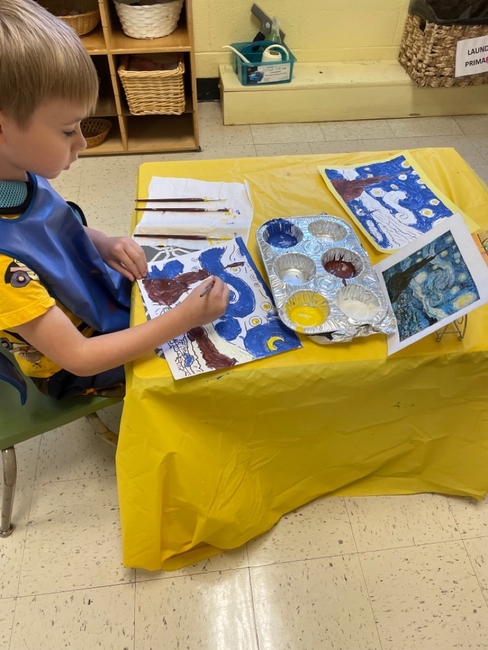
A wide range of tools, media, and techniques are introduced and used by the children for creative self‑expression, for illustrating their curriculum work, and for hands‑on construction and experimentation. Appreciation for art and music is nurtured through group discussions of prints by well‑known artists and through listening to selected musical recordings.
Your family's Montessori journey begins here.
Enroll today.